

The core working principle of shadowless lamps is to use the synergistic effect of multiple light sources and scientific light path design, so that the shadows generated by each light source are covered by each other’s light, ultimately forming uniform illumination without obvious shadows in the surgical area. The principle can be broken down into three key steps, as follows:
1、 Multi light source layout: the core from “single shadow” to “shadowless”
The generation of shadows comes from the obstruction of a light source by an object. When a single light source shines, a clear and fixed shadow will be formed behind the obstruction; And shadowless lamps fundamentally solve this problem through “complementary multiple light sources”:
Circular array design: Dozens to hundreds of independent small light sources (such as LED beads) are densely arranged in a circular or honeycomb pattern on the lamp panel, each with its own reflector and lens, forming multiple “sub light source systems”.
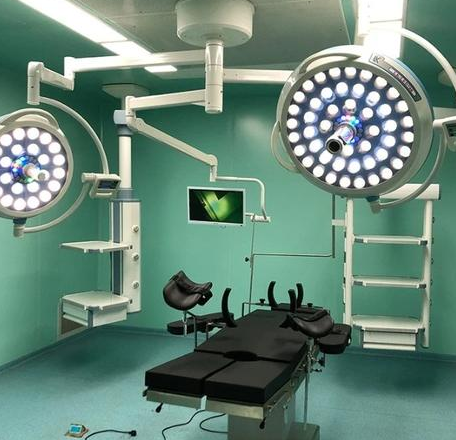
Shadow overlay cancellation: When all sub light sources illuminate the surgical area simultaneously, the small shadow generated by a certain light source being obstructed by surgical instruments or the doctor’s hand will be directly illuminated by sub light sources from other angles around it. In the end, countless tiny shadows overlap and cancel each other out, making it impossible to observe obvious dark areas with the naked eye, achieving a “shadowless” effect.
For example, if three flashlights are used to illuminate an apple in a circular pattern, the shadow of the apple illuminated by a single flashlight will be covered by the light from the other two flashlights, leaving only a very faint “shadow” below the apple. This is consistent with the multi light source deblurring principle of shadowless lamps.
2、 Optical path focusing: ensuring precise convergence of light rays
Multi light sources require precise optical path design to concentrate light in the surgical area, avoiding dispersion that may result in insufficient brightness or residual shadows, mainly relying on two components:
Reflector: Each sub light source corresponds to a parabolic reflector, which can reflect the divergent light emitted by the light source as parallel or approximately parallel light, reducing the loss of light during propagation.
• Focusing lens group: The reflected light is refracted twice by the lens and finally converged at a fixed “cold light focal point” (usually 50-70 centimeters away from the lamp plate, which is commonly used for surgical operations). The focal points of all sub light sources coincide to ensure that the surgical incision and deep tissues are uniformly illuminated, and the angle of the light rays is close to vertical, further reducing the side effects caused by oblique light.
3、 Cold light and color temperature control: key optimization for adapting to surgical scenes
In addition to “shadowless”, optical path design also needs to address the issues of “heat” and “color rendering”, which are important guarantees for surgical safety:
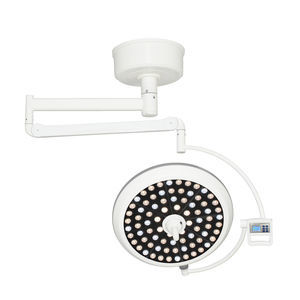
Cold light technology: When the light source emits light, it produces infrared radiation (heat source). Shadowless lamps filter out more than 90% of the infrared radiation by adding an infrared filter in the light path; At the same time, the lamp body is equipped with a built-in heat dissipation system (such as aluminum heat sinks and fans) to ensure that the light shining on the surgical area is “cold” and safe, avoiding tissue drying, cell damage, or affecting patient temperature.
• Stable color temperature adjustment: By using a color temperature filter in the optical path, the color temperature of the light source is controlled between 5000-6000K (close to noon natural light), ensuring that the tissue color during surgery (such as normal tissue pale pink, bleeding bright red, necrotic tissue dark purple) is truly restored, helping doctors judge the tissue status through color and avoid misjudgment caused by color temperature deviation.
In summary, the working principle of shadowless lamps is the synergistic effect of “multi light source deblurring+precise light path focusing+cold light color temperature control”, ultimately providing a clear, uniform, and safe lighting environment for surgery.
Post time: Sep-10-2025