

Medical beds are crucial equipment in medical institutions and home care. Proper use can ensure patient safety and comfort, and extend the lifespan of the equipment. The following are core precautions during use:
1. Preparation and inspection before use
Read the instruction manual: Before using the product for the first time, be sure to carefully read the instruction manual to familiarize yourself with the names, functions, operation methods, and load limits of each component.
Environmental inspection:
Ensure there is sufficient space around the bed (it is recommended to have a passage of at least 60cm on one side) for ease of operation and emergency transfer.
The ground should be flat, dry, and free of obstacles to avoid collisions or toppling when the bed is moved.
Confirm that the power outlet is well grounded (for electric beds) and the wires are not damaged or tangled.
Equipment inspection:
Stability: Check whether the bed’s casters are fully locked (when fixed) or whether the brakes are effective (when moving). Shake the bed to confirm there is no abnormal shaking.
Guardrail: Check whether the guardrail on both sides can be raised and lowered flexibly, and whether the lock catch is secure. Ensure that the guardrail is at an appropriate height (usually, when the patient is lying down, the top of the guardrail should be higher than the patient’s chest).
Bed surface: Check whether the mattress is flat, undamaged, and fits snugly with the bed frame. For adjustable beds, check whether the joints such as the backboard and leg board operate smoothly, without any jamming or abnormal noise.

Safety equipment: Confirm that accessories such as call bells and seat belts are functioning properly and placed in easily accessible locations.
II. Safety points during operation
Patient transfer and body position adjustment:
Before adjusting the bed height, back or leg angles, be sure to inform the patient and confirm that their body is not close to the moving joints, and that their clothing and bedding are not stuck.
When using the electric function, continuously press the control button and closely observe the patient’s response and the bed’s movement. Release the button at any time to stop. Avoid automatic adjustment without supervision.
When turning or moving the patient, the guardrail on the side closer to the operator should be lowered, but it is essential to ensure that the guardrail on the other side is raised and locked. It is strictly prohibited to lower both guardrails simultaneously when the patient is alone in bed.
After adjusting the patient’s position, it is necessary to check whether the patient’s posture is comfortable and whether the pressure is evenly distributed. Special attention should be paid to bony prominences such as the sacrococcygeal joint, ankles, and elbows to prevent pressure ulcers.
Use of protective equipment:
For patients who are unconscious, agitated, or at risk of falling, bed rails must be used and properly secured throughout the entire process. The gap between the rails should meet standards to prevent limbs or heads from getting stuck.
Based on the patient’s condition, restraint belts or safety belts should be used reasonably, but the principle of minimizing restraint must be followed. Regular checks should be made on the blood circulation and skin condition of the restrained area, and the restraint should be loosened at the prescribed time.
Cleaning and disinfection:
Wipe the surface of the bed frame, guardrail, controller, etc. with clean water or neutral detergent daily. Avoid using corrosive, strong acid or strong alkali detergents to prevent damage to metal, plastic parts, or circuits.
Follow hospital infection control procedures and perform terminal disinfection when there is obvious contamination from contact with different patients or bed units. During disinfection, the power must be disconnected to prevent liquids from infiltrating internal components such as controllers and motors.
The mattress should be disinfected using an appropriate method based on its material to prevent damage to the internal padding or the growth of mold caused by immersion.
III. Daily maintenance and fault handling
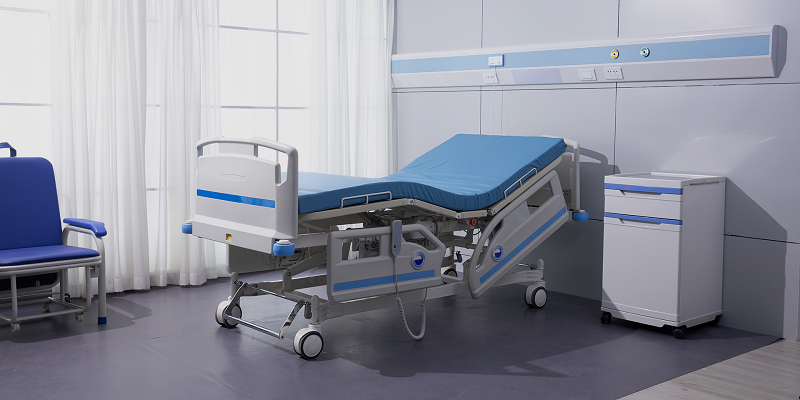
Regular maintenance:
Regularly (it is recommended to do so monthly) check whether all fasteners (such as screws and nuts) are loose, especially in key parts such as guardrail hinges, casters, and lifting mechanisms.
For movable parts such as casters and bearings, regularly add lubricant according to the instructions to maintain their smooth rotation.
Check the cables and plugs for aging and damage. The battery (if any) of the electric bed should be maintained periodically as required.
Fault handling:
Once issues such as abnormal noises from the bed, operational malfunctions, loose guardrails, brake failures, and electrical circuit faults are discovered, the equipment should be immediately stopped and a “Out of Order” sign should be hung.
It is strictly prohibited for non-professionals to disassemble and repair the equipment, especially the mechanical and electrical parts of electric beds. Contact the equipment department or professional maintenance personnel for assistance.
In case of emergency (such as the patient being trapped or at risk of electric shock), first ensure the patient’s safe removal from the dangerous environment, then cut off the power supply, and immediately seek help.
Post time: Mar-13-2026