

To ensure the smoothness of the geogrid laying, the core is to control the entire process from the base, unfolding, fixing, filling and rolling, to avoid unevenness caused by local protrusions, displacement or uneven stress. The specific measures are as follows:
1. Base pretreatment: Build a solid and flat foundation
The foundation is a prerequisite for smoothness, which requires thorough removal of gravel, tree roots, and sharp debris, followed by fine leveling with a grader to ensure that there are no obvious protrusions (error ≤ 5cm) or depressions on the surface; Subsequently, compaction shall be carried out in layers according to the design requirements, with a compaction degree that meets the standard (generally ≥ 95%), to prevent the arching of the grid due to later settlement of the foundation. If the base has a slope, it needs to be leveled along the slope direction to avoid horizontal height differences.
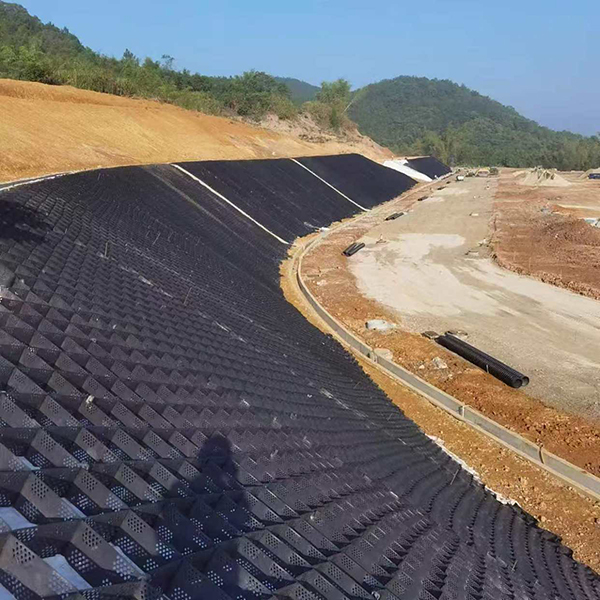
2. Standardized deployment: Stretching in place and laying in the forward direction
When unfolding the cell, it is necessary to fully stretch it according to the design dimensions to ensure that the cells are uniformly diamond shaped (or square shaped), without wrinkles or distortions. After stretching, mark the edge reference line with a marker pen to ensure that the overall layout is straight; It is strictly prohibited to lay in an unstretched state, otherwise the cell size may be uneven and local protrusions may form. At the same time, the laying direction should be consistent with the stress direction of the roadbed/slope to avoid uneven stress caused by lateral tilting.
3. Precise fixation: prevent displacement and deformation
Immediately fix according to the design spacing after laying, and use U-shaped nails (or anchor rods) to drive into the base every 1-2m at the edges and middle, with a fixing depth of ≥ 15cm, to ensure that the grid is tightly attached to the base; The joint should be firmly fixed with dedicated connectors, and the joint should be straight without overlap or gaps to prevent the joint from warping when filling soil. If the laying area is large, it can be laid and fixed in sections to avoid overall displacement.
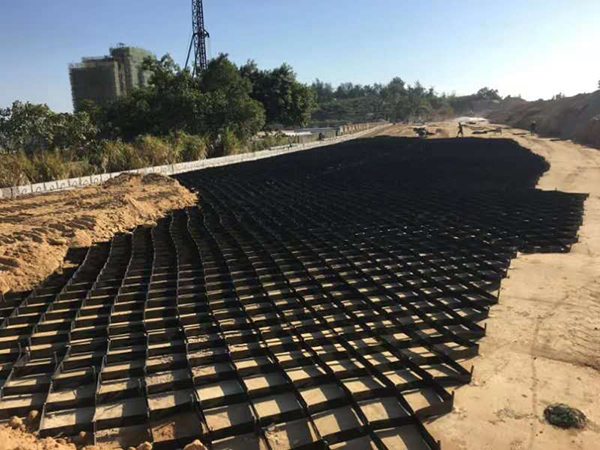
4. Scientific filling and compaction: avoid lattice distortion under stress
Fill the soil layer by layer from the middle of the compartment to both sides, with a thickness of 20-30cm for each layer. Fill the cells manually first, and then compact them with lightweight equipment (such as small rollers and flat compactors). It is strictly prohibited to directly compact the empty compartment; When rolling, push from the edge to the middle at a slow speed (≤ 2km/h) to avoid deformation of the grid due to heavy pressure; The filling material should be graded soil with a particle size of ≤ 5cm, ensuring that the gaps are filled and forming uniform support to prevent local voids from causing unevenness.
5. Process inspection: timely correction of errors
Check the flatness with a ruler at any time during laying, and immediately stretch and adjust if wrinkles or displacement are found; If there are local depressions after filling and compaction, they should be promptly filled and compacted; Reserve 5-10cm of expansion and contraction during slope laying to avoid lattice cracking caused by temperature changes or soil settlement, which may affect the flatness.
Post time: Dec-05-2025