

Cement blanket is a blanket shaped waterproof membrane made of three materials: dry concrete mixture, woven fabric, and polyester non-woven fabric. Dry concrete particles are fixed between non-woven fabric and plastic woven fabric by needle punching method. After absorbing water, dry concrete solidifies into a whole slope protection material in the limited space of the upper and lower layers of non-woven fabric.
Construction technology of cement blanket.
1: Plan and measure to ensure a certain slope to allow water flow from the upper end to the lower end; Clean up the construction site, set up construction lines according to the design drawings, and re measure the drainage slope. The construction line should be set according to the design requirements, and both sides of the ditch should be flat. There should be no loose soil or voids on the slope inside the ditch. The water damaged areas should be compacted, and debris and gravel inside the slope should be removed. The laying materials can be laid vertically and horizontally. Please make sure to level the foundation, otherwise it will affect the appearance quality!
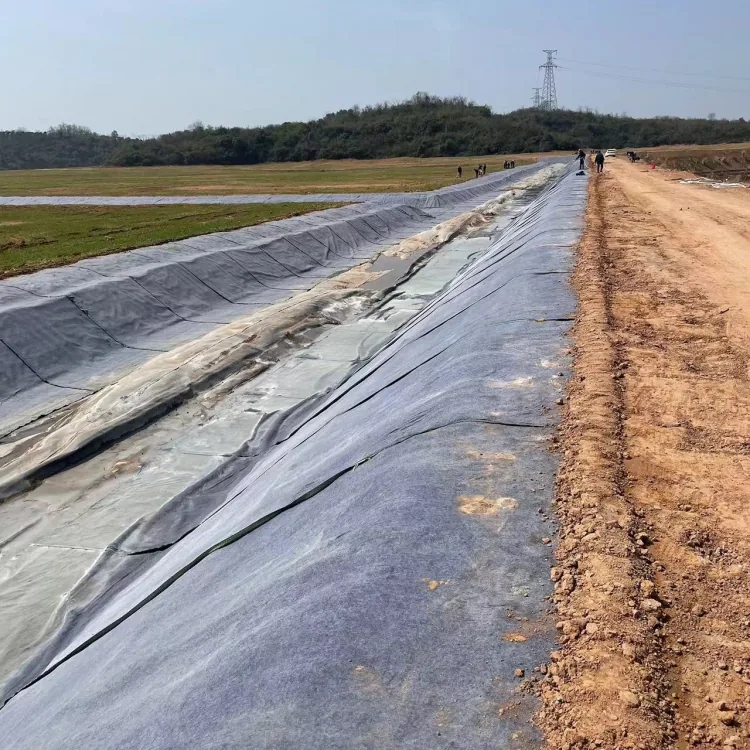
Joint treatment of cement blanket: Dig a 10cm width horizontally at the overlap of adjacent cement blankets, with a depth of the first generation pit of the cement blanket. Place and flatten the cement blanket joints at the stacking location. Press the upper cement blanket onto the lower cement blanket in the direction of the water flow, with a minimum overlap of 10cm. Secure the two cement blankets with a φ 5 * 38mm stainless steel screw. Use rivets to fix the edges of the material along the ditch edge, and use rivets to fix the overlapping area. After fixation, cover the edges with soil.
2: Watering and solidification: Before watering, the entire paving should be inspected and accepted, and it should be thickened before watering! Watering 9kg per square meter (thickness calculated as 10mm). Watering is necessary. Spray water evenly from the edge to the middle. Good spraying. The flow rate is 400ml/min until the color of the cement blanket darkens. Do not use high-pressure water columns! Do not step on water after delivery. When the temperature is ≤ 5 ℃, insulation measures should be taken; When the average temperature during day and night exceeds 30 ℃, the surface should be covered with plastic film or geotextile to maintain moisture. Watering and maintenance time shall not be less than 3 days. After spraying water on the cement carpet, the cement will quickly solidify.
The main characteristics of cement blanket.

1. Easy to use.
The new type of cement blanket can be rolled up in bulk. It can also be provided in rolls for convenient manual loading and unloading transportation, without the need for large lifting machinery. Concrete is prepared in scientific proportions without the need for on-site preparation, and there is no problem of excessive hydration. Cement blankets can solidify underwater or in seawater.
2. Rapid solidification molding.
Once the hydration reaction occurs during watering, the size and shape of the cement blanket can still undergo necessary processing within 2 hours and can harden 80% within 24 hours. Special formulas can also be used according to users’ specific requirements to achieve rapid or delayed solidification.
3. Environmentally friendly.
Cement blanket is a low-quality and low-carbon technology. In many applications, materials used are 95% less than ordinary concrete. Its alkali content is limited, the erosion rate is very low, and it has little impact on the local ecology.
4. Flexibility of application.
Cement blanket has good drape and can even form a hyperbolic shape according to the complex shape of the covered object surface. The cement blanket before solidification can be cut or cut with ordinary hand tools.
5. High material strength.
The fibers in cement blankets can enhance material strength, prevent cracking, absorb impact energy, and form stable failure modes.
6. Long term durability.
Cement blankets have good chemical resistance, resistance to wind and rain erosion, and do not degrade under ultraviolet radiation in sunlight.
Post time: Oct-24-2025